BPC-157 dosage calculator
BPC-157 (Body Protection Compound 157) reconstitution and dosage math for 5mg, 10mg, and 30mg lyophilized vials. Calculate draw units in real time on a 1mL U-100 insulin syringe.
How to use this BPC-157 dosage calculator
This BPC-157 dosage calculator runs reconstitution math live for the most common BPC-157 vial sizes — 5mg, 10mg, and 30mg lyophilized vials — and returns the exact mark to draw to on a 1mL U-100 insulin syringe. The defaults above (5mg vial, 2mL bacteriostatic water, 250mcg target dose) match the most common research protocol and pull to the 10-unit mark on a U-100 syringe.
Pick your BPC-157 vial size
The supplier presets above cover the three vial sizes most commonly available: 5mg lyophilized vial (the standard), 10mg lyophilized vial (better cost-per-mg for longer protocols), and 30mg lyophilized vial (bulk research use). Tapping a supplier preset auto-fills both the vial milligrams and a sensible BAC water volume. Override either value if your supplier uses a non-standard size.
Pick your BAC water volume
BPC-157 reconstitutes cleanly in 1–3mL of bacteriostatic water for a 5mg vial, or 2–5mL for a 10mg vial. The default 2mL on a 5mg vial yields a 2.5 mg/mL concentration — common because 250mcg pulls to a clean 10U mark and 500mcg pulls to 20U, both easy to measure on a U-100 syringe.
Set your BPC-157 target dose
Most BPC-157 research protocols sit between 250mcg and 500mcg per injection, dosed once or twice daily depending on purpose. Enter your dose in micrograms, and the calculator returns your U-100 syringe draw, injection volume, concentration, and total doses per vial. The reconstitution table below shows the same math across BAC water volumes of 1mL, 2mL, 3mL, and 5mL — useful before you commit to a BAC volume.
Read the U-100 syringe units
The "draw to" output is the only number you actually need at the bench — pull the plunger back to that mark on a 1mL U-100 insulin syringe. The visual syringe above the inputs shows the fill in real time so you can sanity-check before drawing.
The full protocol in your pocket.
Reconstitution math is step one. Running a peptide protocol means reminders, rotation, adherence, and history. PeptideMaxxers handles all of it — offline-first, privacy-first, native SwiftUI.
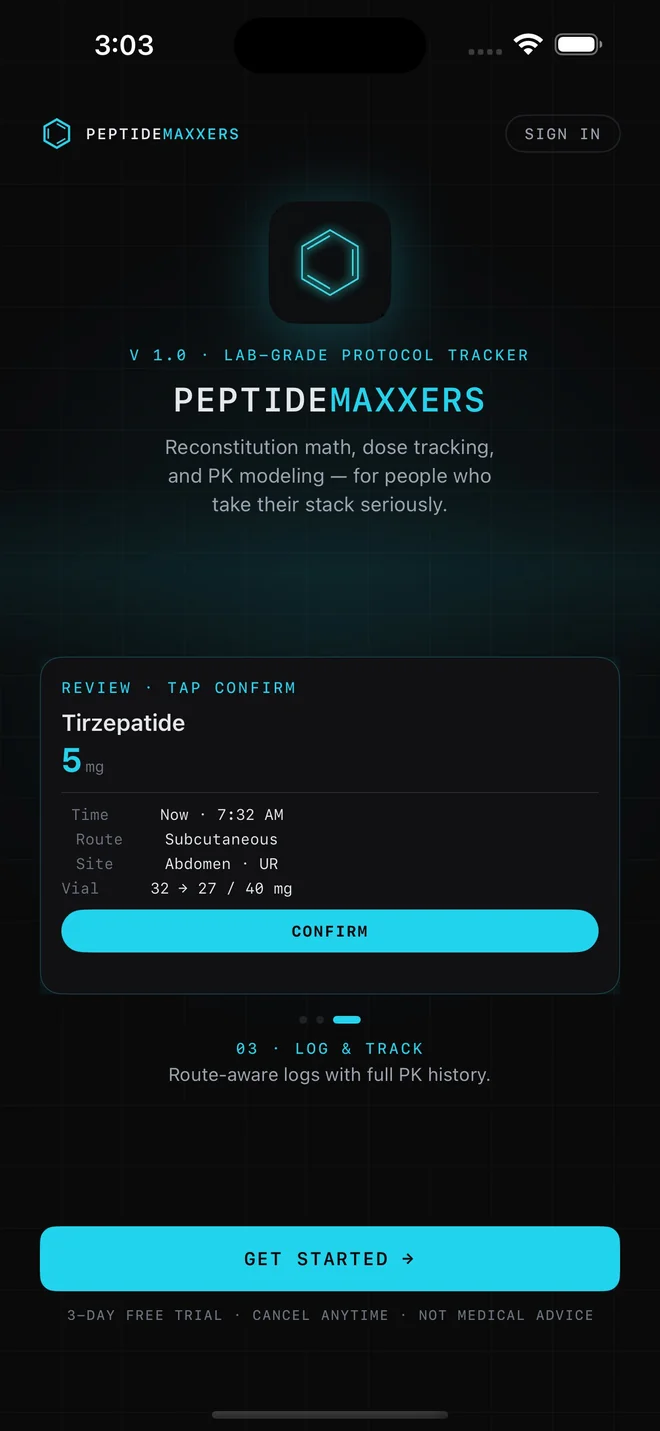
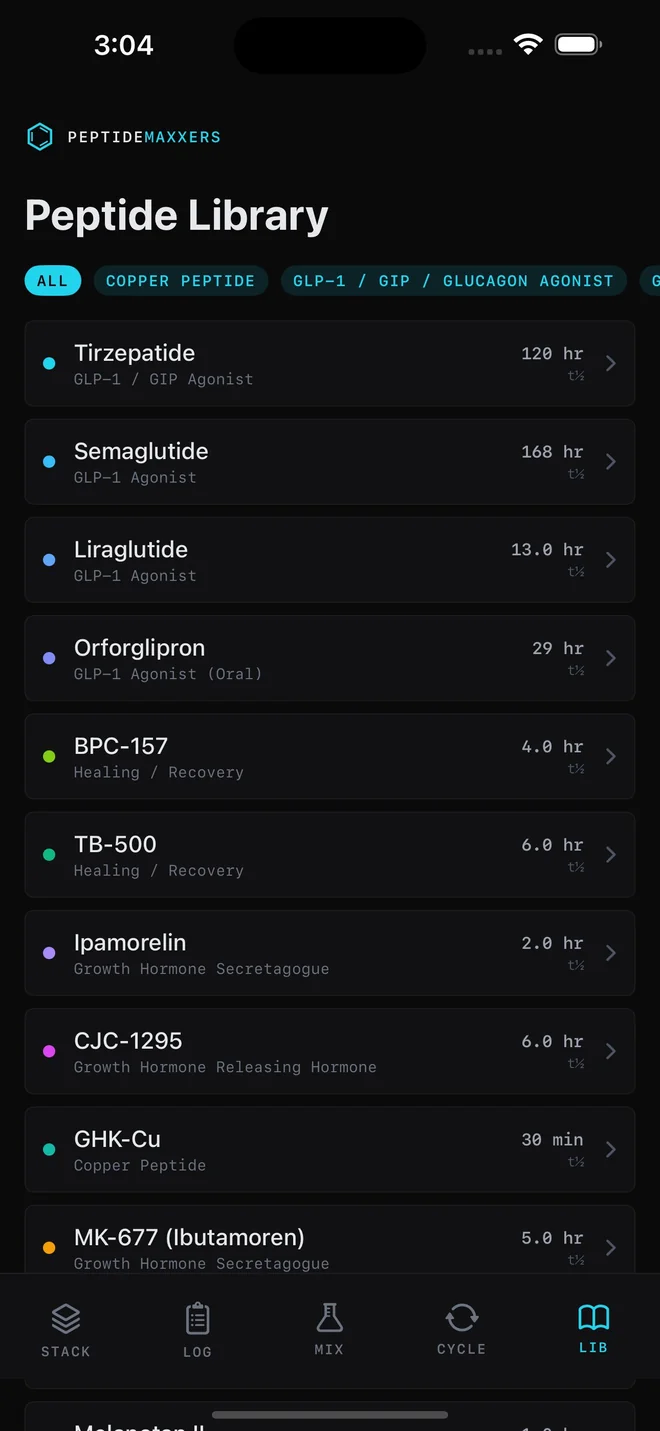
This calculator handles the math. The app handles the protocol.
BPC-157 dosage and reconstitution guide
BPC-157 (Body Protection Compound 157) is a synthetic 15-amino-acid peptide derived from a sequence in human gastric juice, studied for tendon repair, ligament healing, gastrointestinal protection, and systemic recovery support. This guide covers the BPC-157 dose math, the BPC-157 dosage chart by purpose, reconstitution at 5mg and 10mg vial sizes, injection sites, cycle length, half-life, and the BPC-157 + TB-500 stack — every number you need to run a complete protocol.
BPC-157 dosage chart by purpose
BPC-157 dosing varies by research target. The values below are common starting points referenced across published research and community protocols — they are not medical recommendations. All doses assume subcutaneous or intramuscular injection of reconstituted BPC-157 unless otherwise noted.
| Research purpose | Daily dose | Frequency | Typical cycle |
|---|---|---|---|
| Tendon / ligament recovery | 250–500 mcg | 1–2× daily, IM near injury site | 4–6 weeks |
| Gut / GI healing | 250–500 mcg | 1–2× daily, oral or subQ | 4–8 weeks |
| General systemic / wellness | 200–250 mcg | 1× daily, subQ | 4 weeks on / 2 weeks off |
| Joint support (knee, shoulder, elbow) | 250 mcg | 1× daily, IM near joint | 4–6 weeks |
| Post-surgical / injury recovery | 500 mcg | 2× daily, IM near site | 6 weeks |
| Oral / capsule (gut-targeted) | 250–500 mcg | 1–2× daily oral | 4–8 weeks |
BPC-157 concentration matrix — vial size × BAC water
Auto-generated from supplier vial sizes against the standard BAC water volumes. Use this to choose your reconstitution before you draw.
| Vial size | 1 mL BAC | 2 mL BAC | 3 mL BAC | 5 mL BAC |
|---|---|---|---|---|
| 5 mg | 5.0 mg/mL | 2.5 mg/mL | 1.7 mg/mL | 1.0 mg/mL |
| 10 mg | 10.0 mg/mL | 5.0 mg/mL | 3.3 mg/mL | 2.0 mg/mL |
| 30 mg | 30.0 mg/mL | 15.0 mg/mL | 10.0 mg/mL | 6.0 mg/mL |
Draw units at common BPC-157 doses
U-100 insulin syringe units to draw, computed at the most common BPC-157 reconstitution (2mL BAC water).
| Vial (at 2mL BAC) | 200 mcg | 250 mcg | 500 mcg | 750 mcg | 1000 mcg |
|---|---|---|---|---|---|
| 5 mg | 8.0 U | 10.0 U | 20.0 U | 30.0 U | 40.0 U |
| 10 mg | 4.0 U | 5.0 U | 10.0 U | 15.0 U | 20.0 U |
| 30 mg | 1.3 U | 1.7 U | 3.3 U | 5.0 U | 6.7 U |
BPC-157 reconstitution — 5mg and 10mg vials
The 5mg lyophilized vial is the most common BPC-157 supplier format. Reconstitution at 2mL of bacteriostatic water yields a 2.5 mg/mL concentration; a 250mcg dose pulls to 10U on a U-100 syringe and a 500mcg dose pulls to 20U — both clean, easy-to-measure marks. The 10mg vial reconstituted with 2mL yields 5 mg/mL, halving every draw (250mcg = 5U). The 30mg vial typically uses 5mL of BAC water, yielding 6 mg/mL.
BPC-157 injection — subQ, IM, oral, and nasal
Subcutaneous (subQ) is the default for systemic dosing — abdomen, flank, or thigh, rotating sites. The needle is shallow (5–8mm) and the injection is essentially painless on a U-100 syringe. Intramuscular (IM) near the injury site is the standard for tendon, ligament, and joint applications — the rationale is local concentration at the target tissue. Common IM sites include shoulder (deltoid or supraspinatus), elbow, wrist, knee (quadriceps near the joint), and Achilles. Oral BPC-157 (capsule or sublingual) is used primarily for gut-targeted applications because BPC-157 is unusually stable in gastric acid for a peptide — though bioavailability via oral routes for systemic targets is debated. Nasal spray BPC-157 is a niche delivery format for upper-respiratory or neurological research targets; dose conversion from injection is not 1:1.
BPC-157 cycle length and protocol
Typical BPC-157 cycles run 4–6 weeks of daily dosing followed by 2–4 weeks off. For acute injury or post-surgical use, some protocols extend to 8 weeks at higher doses (500mcg twice daily) for the first 2–3 weeks, then taper to maintenance (250mcg once daily). There is no published evidence of tolerance development with BPC-157, so back-to-back cycles are common in injury-recovery contexts. A typical 4-week cycle on a 5mg vial at 250mcg/day yields 20 doses per vial — exactly one vial per cycle.
BPC-157 half-life
BPC-157 has an injection half-life in the range of 4 hours, though the functional duration of biological effect appears longer due to its mechanism of action on growth-factor pathways and angiogenesis. The short serum half-life is why most protocols use once- or twice-daily dosing rather than less frequent injection schedules.
BPC-157 + TB-500 stack
The BPC-157 and TB-500 stack is one of the most-discussed peptide combinations in injury-recovery research. The two compounds are complementary: BPC-157 drives angiogenesis (new blood vessel formation) and growth-factor pathway activation; TB-500 (a fragment of thymosin beta-4) drives cell migration to injury sites and actin-cytoskeleton remodeling. Common stack protocols run BPC-157 at 250–500 mcg daily alongside TB-500 at 2–2.5 mg twice weekly (loading phase: 4–6 weeks) tapering to once weekly maintenance. Some suppliers offer pre-mixed BPC-157 + TB-500 blend vials at 5mg of each compound per vial; the calculator handles single-compound math, so for blends, calculate each compound independently.