GHK-Cu dosage calculator
GHK-Cu (copper peptide) dosage calculator with reconstitution math for 50mg, 100mg, and 200mg lyophilized vials. Live U-100 insulin syringe draw for subcutaneous protocols.
How to use this GHK-Cu dosage calculator
This GHK-Cu dosage calculator runs reconstitution math for the standard GHK-Cu vial sizes — 50mg, 100mg, and 200mg lyophilized vials, the larger sizes typical for copper peptide research. Defaults above (50mg vial, 2mL bacteriostatic water, 2mg target dose) match the most common subcutaneous GHK-Cu protocol and pull to the 8-unit mark on a U-100 syringe.
Pick your GHK-Cu vial size
GHK-Cu vials run larger than most peptides because doses are larger — typical injectable doses are 1–3 mg compared to 250 mcg for BPC-157. The supplier presets cover the three sizes you'll see: 50mg lyophilized vial (the standard), 100mg lyophilized vial (extended cycles), and 200mg lyophilized vial (longest protocols). Tapping a preset auto-fills both vial milligrams and BAC water volume.
Pick your BAC water volume
GHK-Cu reconstitutes cleanly at 2mL of bacteriostatic water for a 50mg vial — a 25 mg/mL concentration where a 2mg dose pulls to a clean 8U mark. A 100mg vial typically uses 3mL (33.3 mg/mL); a 200mg vial uses 5mL (40 mg/mL). The reconstituted solution will have a faint blue tint from the copper — this is normal and expected.
Set your GHK-Cu target dose
GHK-Cu is dosed in milligrams — switch the unit toggle to mg. Most subcutaneous GHK-Cu research protocols use 1–3 mg per injection, dosed daily for skin and systemic targets, or every other day for some hair-research protocols. Enter your dose and the calculator returns U-100 units, injection volume, concentration, and doses per vial.
Read the U-100 syringe units
Pull the plunger to the indicated unit mark on a 1mL U-100 insulin syringe. At default settings (50mg/2mL/2mg dose), the draw is 8U — a small, easy-to-measure volume. The visual syringe above shows the fill in real time so you can confirm before drawing.
The full protocol in your pocket.
Reconstitution math is step one. Running a peptide protocol means reminders, rotation, adherence, and history. PeptideMaxxers handles all of it — offline-first, privacy-first, native SwiftUI.
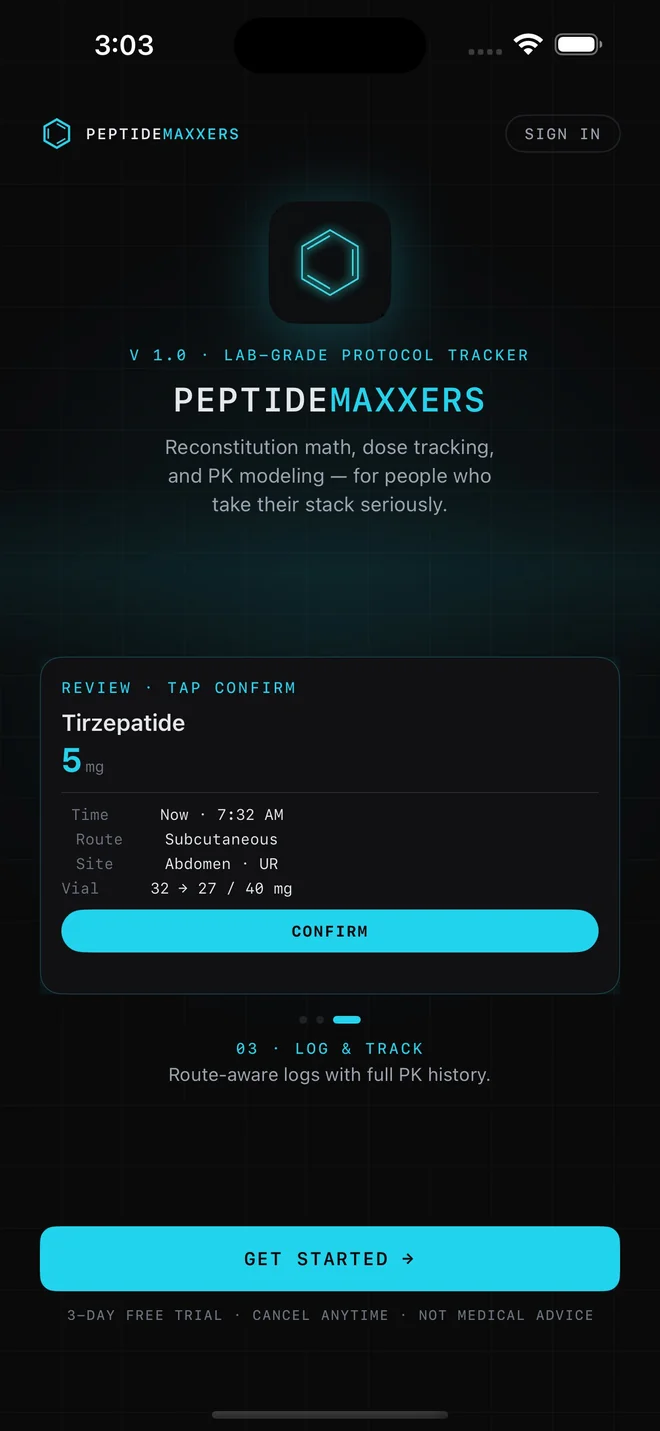
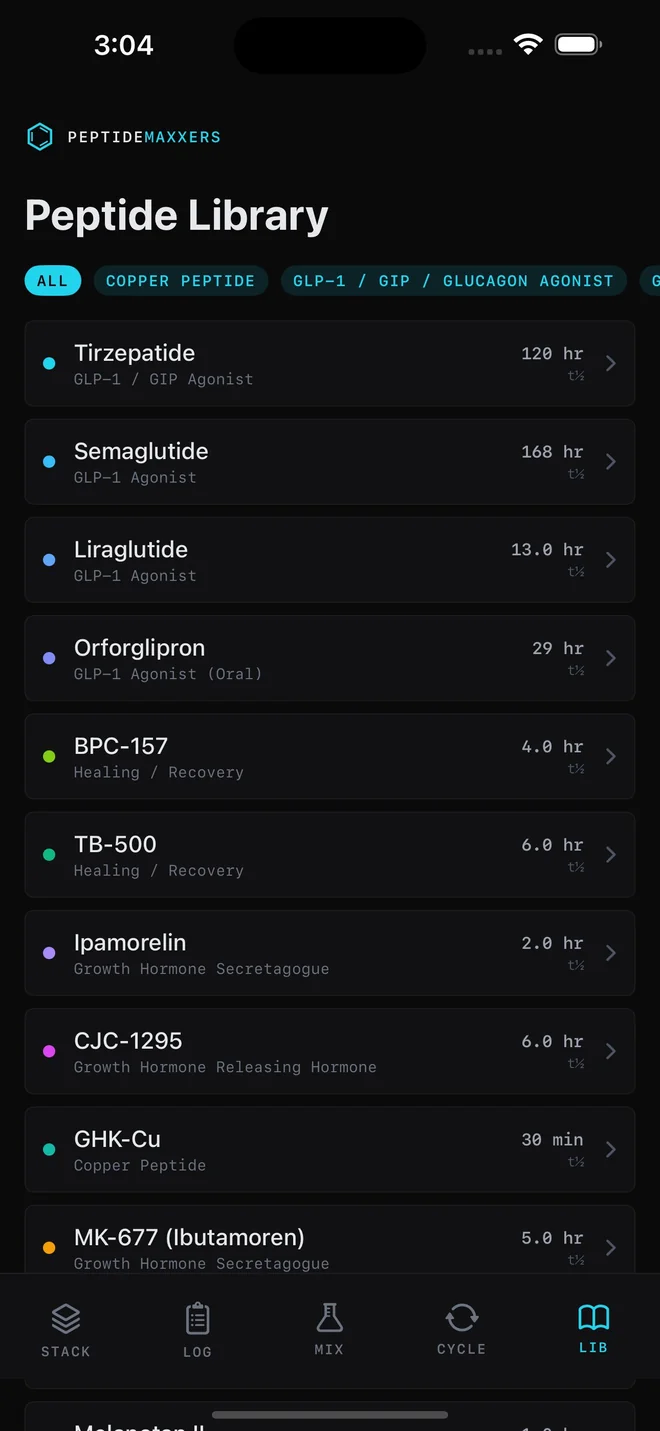
This calculator handles the math. The app handles the protocol.
GHK-Cu dosage and reconstitution guide
GHK-Cu is a naturally occurring tripeptide-copper complex (glycyl-L-histidyl-L-lysine bound to a copper ion) studied for skin regeneration, wound healing, hair follicle stimulation, anti-inflammatory effects, and systemic anti-aging research. This guide covers GHK-Cu dose math, the GHK-Cu dosage chart by purpose, reconstitution at 50mg / 100mg / 200mg vial sizes, injection sites, cycle length, subcutaneous vs sublingual vs topical delivery, and the trade-offs between injectable copper peptides and topical copper peptide skin care products.
GHK-Cu dosage chart by purpose
GHK-Cu dosing varies by research target. Subcutaneous injection is the standard for systemic and aesthetic dosing; sublingual and topical are used as adjunct or alternative routes. Doses below are common research and community protocol values, not medical recommendations.
| Research purpose | Daily dose | Frequency / route | Typical cycle |
|---|---|---|---|
| Skin / anti-aging (systemic) | 1–2 mg | 1× daily, subQ | 4–8 weeks |
| Hair growth research | 1–2 mg | 1× daily or every other day, subQ scalp-adjacent | 8–12 weeks |
| Wound healing | 1–3 mg | 1–2× daily, subQ near site | 2–4 weeks |
| Joint / connective tissue | 2–3 mg | 1× daily, subQ | 4–6 weeks |
| Sublingual systemic | 1–2 mg | 1× daily under tongue | 4–8 weeks |
| Topical (cosmetic) | 0.5–2% concentration in cream | 1–2× daily applied to skin | Continuous use |
GHK-Cu concentration matrix — vial size × BAC water
Auto-generated from supplier vial sizes against the standard BAC water volumes. Use this to choose your reconstitution before you draw.
| Vial size | 1 mL BAC | 2 mL BAC | 3 mL BAC | 5 mL BAC |
|---|---|---|---|---|
| 50 mg | 50.0 mg/mL | 25.0 mg/mL | 16.7 mg/mL | 10.0 mg/mL |
| 100 mg | 100.0 mg/mL | 50.0 mg/mL | 33.3 mg/mL | 20.0 mg/mL |
| 200 mg | 200.0 mg/mL | 100.0 mg/mL | 66.7 mg/mL | 40.0 mg/mL |
Draw units at common GHK-Cu doses
U-100 insulin syringe units to draw, computed at the most common GHK-Cu reconstitution (2mL BAC water).
| Vial (at 2mL BAC) | 1 mg | 2 mg | 3 mg | 5 mg |
|---|---|---|---|---|
| 50 mg | 4.0 U | 8.0 U | 12.0 U | 20.0 U |
| 100 mg | 2.0 U | 4.0 U | 6.0 U | 10.0 U |
| 200 mg | 1.0 U | 2.0 U | 3.0 U | 5.0 U |
GHK-Cu reconstitution — 50mg, 100mg, 200mg vials
The 50mg lyophilized vial is the standard GHK-Cu supplier format. Reconstitution at 2mL of bacteriostatic water yields a 25 mg/mL concentration; a 1mg dose pulls to 4U and a 2mg dose pulls to 8U on a U-100 syringe — both small, precise marks. The 100mg vial reconstituted with 3mL yields 33.3 mg/mL (1mg = 3U); the 200mg vial with 5mL yields 40 mg/mL (1mg = 2.5U). The reconstituted GHK-Cu solution will have a faint blue or aqua tint from the bound copper — this is normal and expected.
GHK-Cu injection — subQ, sublingual, and topical
Subcutaneous (subQ) is the standard injection route for systemic GHK-Cu dosing — abdomen, flank, or thigh, with site rotation. Some hair-research protocols use scalp-adjacent subQ injections (forehead hairline, behind ears, nape of neck) on the rationale of local concentration at the target follicles. Sublingual GHK-Cu (a few drops of reconstituted solution under the tongue, held for 60–90 seconds before swallowing) is used as a needle-free alternative; bioavailability is lower than injection but absorption avoids first-pass metabolism. Topical GHK-Cu (compounded into cream, serum, or lotion at 0.5–2% concentration) targets cosmetic skin applications directly — this is the form used in copper peptide skin care products. Topical and injectable applications are not interchangeable; topical does not produce systemic concentrations comparable to subQ injection.
GHK-Cu cycle length
Subcutaneous GHK-Cu cycles typically run 4–8 weeks of daily dosing with a 2–4 week break before repeating. Hair-research protocols extend longer (8–12 weeks) given the slow timeline of follicle response. Wound-healing applications are short and acute (2–4 weeks). Topical use is generally continuous since systemic exposure is minimal. There is no documented tolerance development with GHK-Cu, so cycles can be repeated.
GHK-Cu vs topical copper peptides
The topical copper peptide skin-care market (serums and creams from cosmetic brands) uses GHK-Cu or related tripeptide-copper complexes formulated at 0.5–2% concentration for dermal absorption. Topical formulations target skin-surface effects (collagen synthesis stimulation, antioxidant activity in the dermis, wound and barrier repair) and are considered cosmetic, not pharmaceutical. Injectable GHK-Cu produces systemic concentrations orders of magnitude higher than topical products achieve — this is the difference between cosmetic skin support and research-protocol systemic GHK-Cu. The two delivery methods serve different purposes; one does not substitute for the other.
GHK-Cu side effects and tolerability
Subcutaneous GHK-Cu is generally well-tolerated. The most common observation is mild local injection-site reaction (redness, brief stinging) due to the copper component. Some users report a metallic taste with sublingual administration. Systemic side effects in research literature are minimal at standard 1–2 mg daily doses. Higher doses (>3 mg/day) are not well-studied and are not a standard part of any common protocol. Topical use is essentially side-effect-free at cosmetic concentrations.