Melanotan II dosage calculator
Melanotan II (MT2) dosage calculator with reconstitution math for the standard 10mg lyophilized vial. Loading-phase and maintenance protocol math, live U-100 insulin syringe draw for subcutaneous tanning protocols.
How to use this Melanotan II dosage calculator
This Melanotan II (MT2) dosage calculator runs reconstitution math live for the standard MT2 vial size — 10mg lyophilized vial — and returns the exact mark to draw to on a 1mL U-100 insulin syringe. The defaults above (10mg vial, 2mL bacteriostatic water, 500mcg target dose) match a typical maintenance-phase MT2 protocol and pull to the 10-unit mark on a U-100 syringe.
Pick your MT2 vial size
Melanotan II is overwhelmingly sold in 10mg lyophilized vials — the standard supplier format. Some 5mg vials exist but are uncommon. Tap the supplier preset to load the standard 10mg vial; override the vial milligrams field if your supplier uses a different size.
Pick your BAC water volume
MT2 reconstitutes cleanly at 2mL of bacteriostatic water for a 10mg vial — a 5 mg/mL concentration where loading-phase doses (250–500 mcg) pull to small, precise marks (5–10U) and maintenance doses (500–1000 mcg) pull to 10–20U. Some users prefer 1mL of BAC (10 mg/mL) for very small loading doses, but the resulting draws (2.5U for a 250mcg dose) are hard to measure precisely on a standard U-100 syringe.
Set your MT2 target dose
Melanotan II uses a two-phase dosing protocol unique to tanning peptides: a loading phase (small daily doses to gradually build pigmentation) followed by a maintenance phase (larger weekly or twice-weekly doses to maintain tan). Loading-phase doses start at 250 mcg daily and titrate up to 500 mcg daily over 2–3 weeks. Maintenance is typically 500–1000 mcg once or twice weekly. Enter your dose in micrograms and the calculator returns U-100 units.
Read the U-100 syringe units
Pull the plunger to the indicated unit mark on a 1mL U-100 insulin syringe. At default settings (10mg/2mL/500mcg dose), the draw is 10U. The visual syringe shows the fill in real time — drag it directly to scrub through the loading-to-maintenance dose range live.
The full protocol in your pocket.
Reconstitution math is step one. Running a peptide protocol means reminders, rotation, adherence, and history. PeptideMaxxers handles all of it — offline-first, privacy-first, native SwiftUI.

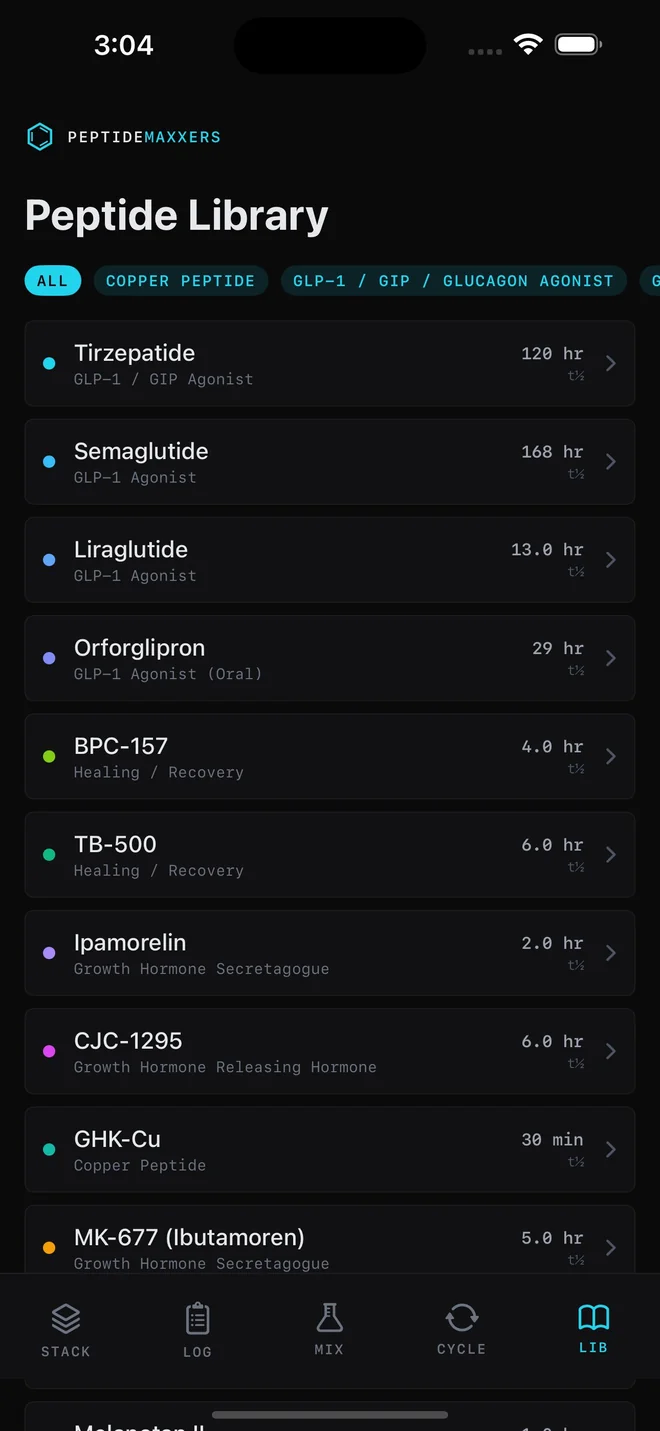

This calculator handles the math. The app handles the protocol.
Melanotan II (MT2) dosage and reconstitution guide
Melanotan II (MT2) is a synthetic 7-amino-acid analog of α-melanocyte-stimulating hormone (α-MSH) that binds melanocortin receptors to stimulate melanin production in skin and induce tanning. Originally developed at the University of Arizona in the 1990s as a potential pharmacological alternative to UV tanning, MT2 was never brought to market as a tanning agent (its derivative Bremelanotide / PT-141 was developed for a different indication — sexual dysfunction). MT2 is widely used as a research peptide in the cosmetic / tanning context. This guide covers MT2 dose math, the loading-then-maintenance protocol unique to tanning peptides, reconstitution at the standard 10mg vial size, half-life, side-effect profile (nausea, increased libido, mole darkening), the differences between subcutaneous injection and nasal spray delivery, and the differences between Melanotan I and Melanotan II.
Melanotan II dosage protocol — loading and maintenance
MT2 uses a two-phase dosing pattern that is not found with most other peptides. The loading phase uses small daily subcutaneous doses to gradually build melanin pigmentation in the skin over 2–4 weeks. Once the desired pigmentation level is reached, the protocol transitions to maintenance dosing at larger but less frequent intervals. Doses below are common values from research and community protocols, not medical recommendations.
| Phase | Dose | Frequency | Duration / notes |
|---|---|---|---|
| Loading week 1 | 250 mcg | 1× daily, subQ | Tolerability assessment — start low |
| Loading weeks 2–3 | 500 mcg | 1× daily, subQ | Continue daily until target tan reached |
| Loading weeks 3–4 (aggressive) | 500–750 mcg | 1× daily, subQ | For users wanting faster results |
| Maintenance (light) | 500 mcg | 1× weekly, subQ | Maintain pigmentation post-loading |
| Maintenance (standard) | 500–1000 mcg | 1–2× weekly, subQ | Most common maintenance pattern |
| Pre-sun exposure | 250–500 mcg | 24 hours before UV | Some users dose before sun exposure |
Melanotan II reconstitution — 10mg vial
The 10mg lyophilized vial is the universal MT2 supplier format. Reconstitution at 2mL of bacteriostatic water yields a 5 mg/mL concentration where a 250mcg loading dose pulls to 5U on a U-100 syringe and a 500mcg dose pulls to 10U — both readable marks. 1mL of BAC water yields 10 mg/mL for users who want larger total dose capacity per vial, but very small loading-phase doses become hard to measure (a 250mcg dose at 10 mg/mL is just 2.5U).
Melanotan II — subcutaneous vs nasal spray
Subcutaneous (subQ) injection is the standard MT2 delivery route — abdomen, flank, or thigh, with site rotation. The dose math above assumes subQ delivery. The needle is shallow (5–8mm) and the injection is essentially painless on a U-100 syringe. Nasal spray MT2 is an alternative delivery format compounded by some suppliers as a needle-free option. Bioavailability of nasal MT2 is significantly lower than subQ (~30–40% absorbed vs subQ baseline), so nasal doses must be roughly 2–3× higher to achieve equivalent systemic effect — and the calculator math doesn't apply directly to nasal delivery. Nasal spray is convenient but less precise; subQ remains the standard for users prioritizing predictable dosing and consistent results.
Melanotan II half-life and dosing timing
MT2 has a serum half-life of approximately 33 hours — long for a small peptide. The long half-life is why maintenance dosing transitions to once or twice weekly after the loading phase: each dose maintains active melanocortin-receptor activation for several days. Loading-phase daily dosing is not pharmacologically necessary based on half-life alone — it accelerates the rate of melanin accumulation in skin by keeping receptor activation continuous through the build-up phase. Once target pigmentation is reached, weekly dosing is sufficient to maintain it.
Melanotan II side effects
MT2 has a distinctive side-effect profile due to its broad melanocortin-receptor agonism. Nausea is common during loading-phase dosing, typically peaks 30–90 minutes after injection, and often improves over the first 1–2 weeks of dosing. Eating before injection and dosing before bed both reduce nausea perception. Facial flushing is common in the first hour after dosing. Increased libido and spontaneous erections in males are well-documented effects of melanocortin-4 receptor activation — Bremelanotide (PT-141), a metabolite of MT2, is FDA-approved specifically for sexual dysfunction based on this mechanism. Mole and freckle darkening occurs because MT2 stimulates melanin production globally, including in existing pigmented lesions. New mole formation has been reported anecdotally and is a theoretical concern. Decreased appetite is common (melanocortin agonism affects central appetite regulation). MT2 should not be used by individuals with a history of melanoma or significant atypical mole burden — pre-existing dermatologic risk should be evaluated before starting.
Melanotan I vs Melanotan II
Melanotan I (afamelanotide, brand name Scenesse) and Melanotan II are different molecules with different applications. Melanotan I is a 13-amino-acid α-MSH analog and is FDA-approved for erythropoietic protoporphyria (a rare light-sensitivity condition). It induces tanning but with significantly fewer side effects than MT2 because it has more selective melanocortin-1 receptor (MC1R) activity — less nausea, less libido effect, less appetite change. Melanotan II is a 7-amino-acid α-MSH analog with broader melanocortin-receptor activity (MC1R, MC3R, MC4R, MC5R), producing both stronger tanning effect AND the broader side-effect profile. MT1 is harder to source as a research peptide and is more expensive; MT2 is the practical choice for tanning research despite the side-effect trade-off.
Melanotan II results and timeline
MT2 results follow a predictable timeline tied to skin cell turnover. Week 1: minimal visible change; first signs of darkening at injection sites. Week 2–3: general skin tone deepening becomes visible, particularly in sun-exposed areas. Loading-phase users typically reach a noticeable tan by week 3. Week 4–6: peak tan develops; existing moles and freckles darken visibly. Maintenance phase: weekly dosing maintains the tan; missed doses cause gradual fade as natural skin turnover (~28 days) replaces pigmented cells. UV exposure during loading dramatically accelerates and deepens results — MT2 sensitizes melanocytes to respond more aggressively to UV, so even brief sun exposure produces more pigmentation than it would without MT2. This is also why MT2 users should be careful with UV exposure during loading: the same sensitization that produces faster tan also produces faster burn risk if unprotected exposure is excessive.