MK-677 dosage calculator
MK-677 (Ibutamoren) dosage reference for oral GH-secretagogue protocols. Standard 12.5–25 mg pre-bed dosing, 8–12 week cycles, side effects, and the MK-677 vs Ipamorelin comparison.
About this MK-677 page
MK-677 (Ibutamoren) is taken orally as a capsule, tablet, or liquid suspension — not injected. There is no reconstitution math to calculate, no bacteriostatic water to mix, and no U-100 syringe draw. Instead, this page is a quick-reference for MK-677 dosage, cycle length, half-life, and the trade-offs of oral GH-secretagogue dosing. The calculator above shows the standard "oral compound" message because there's nothing to draw — for the actual reference math, scroll down to the dosage chart.
Why MK-677 doesn't need a reconstitution calculator
MK-677 (full chemical name: ibutamoren mesylate) is a non-peptide small molecule that acts as a ghrelin-receptor agonist / growth-hormone secretagogue. Because it's a stable small molecule with high oral bioavailability, it ships pre-formulated as capsules or liquid drops at known mg-per-dose concentrations — no powder to dissolve, no sterile injection technique, no syringe required. You take the labeled dose orally. The calculator math used for injectable peptides (vial mg ÷ BAC mL → concentration → U-100 units) does not apply.
What this page does cover
Below the calculator, you'll find the MK-677 dosage chart by purpose, cycle-length protocol, half-life and dosing-timing rationale, side-effect profile (water retention, prolactin, insulin sensitivity, appetite), the difference between MK-677 and injectable GH secretagogues like Ipamorelin, and answers to the most common MK-677 dosage questions. This is reference content; for product information, see mkibutamoren.com.
Standard dosing at a glance
Most common MK-677 protocols use 12.5–25 mg orally once daily, taken before bed. The compound has a long half-life (~24 hours), so a single daily dose maintains continuous receptor activation. Cycles typically run 8–12 weeks on, followed by a 4-week break to manage water retention and prolactin elevation. Higher doses (50 mg+) are not standard and significantly increase side-effect burden without proportional benefit.
The full protocol in your pocket.
Reconstitution math is step one. Running a peptide protocol means reminders, rotation, adherence, and history. PeptideMaxxers handles all of it — offline-first, privacy-first, native SwiftUI.
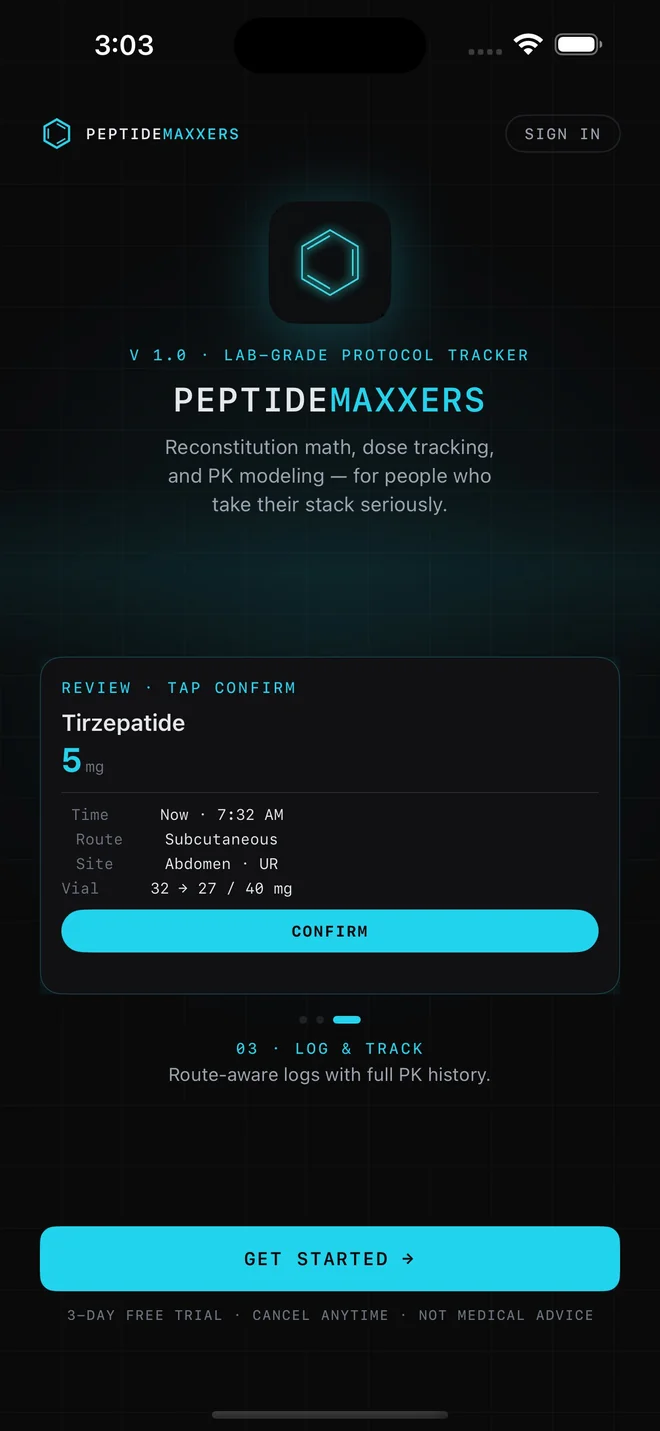
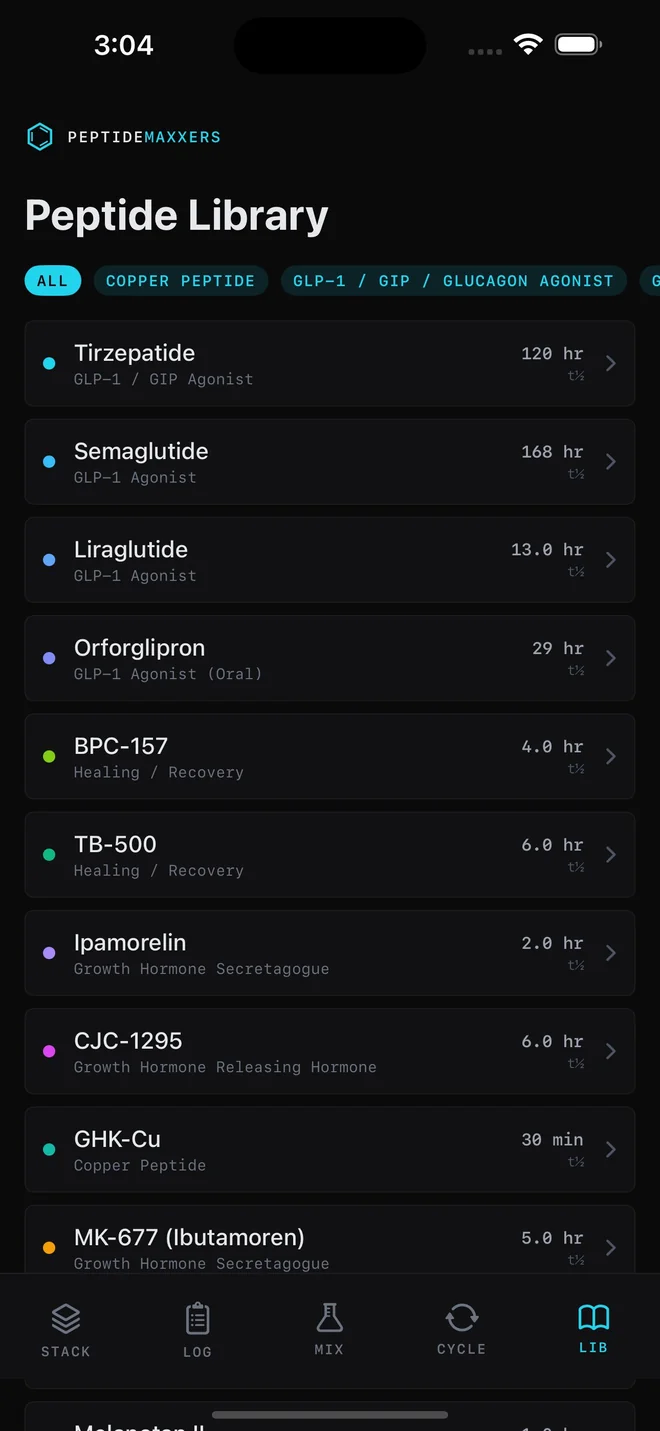
This calculator handles the math. The app handles the protocol.
MK-677 (Ibutamoren) dosage and cycle guide
MK-677 (Ibutamoren) is an orally bioavailable non-peptide ghrelin-receptor agonist developed by Merck in the 1990s as a growth-hormone secretagogue. Despite the "MK-" prefix suggesting a Merck research compound, MK-677 has never received FDA approval for any indication and remains a research compound. It is widely used off-label in research and bodybuilding contexts for sustained elevation of growth hormone (GH) and insulin-like growth factor 1 (IGF-1). This guide covers MK-677 dosage by purpose, cycle length and break protocols, half-life and timing, the difference between Ibutamoren and injectable GH secretagogues like Ipamorelin and Sermorelin, side-effect management (water retention, prolactin, insulin sensitivity, appetite), and the practical answers to the most-asked MK-677 dosage questions.
MK-677 dosage chart by purpose
MK-677 is dosed orally once daily, typically pre-bed to align with the natural overnight GH pulse. Doses below are common ranges from research literature and community protocols, not medical recommendations.
| Research purpose | Daily dose | Timing | Typical cycle |
|---|---|---|---|
| Sleep / GH baseline elevation | 10–12.5 mg | Pre-bed | 8–12 weeks on / 4 off |
| Lean mass / recomp research | 12.5–25 mg | Pre-bed | 8–12 weeks on / 4 off |
| Aggressive recomp / bulking | 25 mg | Pre-bed (some split AM/PM) | 8 weeks on / 4 off |
| Recovery / connective tissue support | 12.5–20 mg | Pre-bed | 8–12 weeks on / 4 off |
| Skin / hair / nail research | 10–12.5 mg | Pre-bed | 12 weeks on / 4 off |
| Higher-dose protocol (not standard) | 50 mg | Pre-bed | 6–8 weeks max — significant side effects |
MK-677 cycle length and break protocol
Standard MK-677 cycles run 8–12 weeks of daily dosing followed by a mandatory 4-week break. The break exists for three reasons: (1) MK-677 chronically elevates aldosterone and produces water retention, which compounds over weeks and benefits from a washout period; (2) prolactin elevation is dose- and duration-dependent and reverses during breaks; (3) sustained ghrelin-receptor activation modestly affects insulin sensitivity, which normalizes during off periods. Some long-term protocols run continuously for 6 months at lower doses (10 mg/day) but this is not standard. Cycles can be repeated indefinitely with breaks; there is no documented receptor desensitization at standard doses.
MK-677 half-life and dosing timing
MK-677 has an exceptionally long half-life of approximately 24 hours, which is the defining feature of the compound. Once-daily dosing maintains continuous ghrelin-receptor activation across the full 24-hour cycle, producing sustained GH and IGF-1 elevation rather than the discrete pulses that injectable GH secretagogues (Ipamorelin, Sermorelin) produce. The standard pre-bed timing serves two purposes: (1) MK-677's appetite-stimulating effect is most disruptive during waking hours and least disruptive overnight, and (2) the compound amplifies the natural overnight GH pulse, maximizing IGF-1 generation. Some protocols split the dose AM/PM at higher daily totals (25 mg+) but this offers no half-life benefit and increases daytime hunger.
MK-677 side effects
The most common MK-677 side effects are direct consequences of its mechanism and are dose-dependent. Increased appetite is universal — MK-677 is a ghrelin-receptor agonist and ghrelin is the primary hunger hormone. This is desired in lean-mass protocols and a problem in fat-loss contexts. Water retention and mild edema from aldosterone elevation typically peak in weeks 2–4 and partially adapt over time. Lethargy and grogginess in the first 1–2 weeks are common as IGF-1 levels rise. Numbness or tingling in the hands (early carpal-tunnel-like symptoms) can develop at higher doses. Insulin sensitivity reduction is mild but measurable — fasting glucose and HbA1c should be monitored on long cycles. Prolactin elevation is dose-dependent. Vivid dreams are nearly universal due to enhanced REM sleep from elevated GH. None of these are typically severe at 12.5–25 mg/day; they scale significantly above 50 mg/day, which is why the higher-dose protocol is not standard.
MK-677 vs Ipamorelin
MK-677 and Ipamorelin both target the ghrelin receptor (GHSR-1a) to elevate growth hormone, but their delivery and pharmacokinetics differ fundamentally. MK-677 is oral, has a 24-hour half-life, and produces sustained continuous GH/IGF-1 elevation. Ipamorelin is injected subcutaneously, has a ~2-hour half-life, and produces discrete GH pulses lasting a few hours. The continuous elevation from MK-677 is convenient (one oral dose) and produces stronger 24-hour IGF-1 elevation, but also drives more side effects (appetite, water retention, prolactin) because ghrelin-receptor agonism is sustained. Ipamorelin's pulsatile dosing produces less sustained IGF-1 elevation but better side-effect tolerability and more closely mimics natural endogenous GH release patterns. Researchers who want strong continuous GH elevation choose MK-677; researchers who prioritize physiological mimicry and tolerability choose Ipamorelin.
MK-677 vs Sermorelin / Tesamorelin
MK-677 (ghrelin-receptor agonist) is mechanistically distinct from Sermorelin and Tesamorelin (GHRH analogs). The two pathways converge on the same outcome (GH release from the pituitary) but through different upstream receptors. The practical differences: MK-677 is oral and once-daily; Sermorelin and Tesamorelin are injected and require reconstitution. MK-677 produces sustained elevation; GHRH analogs produce discrete pulses. MK-677 raises prolactin and aldosterone; GHRH analogs do not significantly. Tesamorelin has FDA approval (HIV lipodystrophy) and Phase III clinical data; MK-677 does not. For research applications prioritizing continuous IGF-1 elevation with oral convenience, MK-677 is the practical choice; for applications mimicking physiological GH pulse patterns or requiring clinical-grade evidence, GHRH analogs are preferred.
Buying MK-677 — capsules, liquid, and powder
MK-677 is sold in three formats. Capsules (typically 10 mg or 25 mg per cap) are the most common and the easiest to dose precisely. Liquid suspensions (typically 25 mg/mL) allow finer dose titration but require an oral syringe and accurate mL measurement. Bulk powder is the cheapest per-mg option but requires accurate milligram-scale weighing for safe dosing — the difference between 12.5 mg and 50 mg is significant in side-effect terms. Capsules are recommended for users new to MK-677; liquid for users running fine-tuned dose titrations; powder only for users with a 0.001 g milligram scale and weighing experience.
MK-677 results timeline
MK-677 produces measurable IGF-1 elevation within 1–2 weeks of starting. Subjective effects follow a predictable timeline: Week 1–2: appetite increase, vivid dreams, mild water retention, possible lethargy. Week 3–4: peak water retention, beginning of measurable lean-mass effects in resistance-trained users, sleep quality typically improved. Week 4–8: visible recomp effects (lean mass gain, modest fat loss in caloric deficit despite appetite), continued sleep quality benefits. Week 8–12: diminishing rate of new gains; this is when most cycles end. The most consistent and rapid effects are appetite and sleep; recomp results vary by training, nutrition, and genetics. For a complete reference on MK-677 results and benefits, see mkibutamoren.com.