Semaglutide dosage calculator
Semaglutide dosage calculator with reconstitution math for 2mg, 5mg, and 10mg lyophilized vials. Full 0.25 → 2.4mg titration schedule, live U-100 insulin syringe draw, and the compounded vs branded comparison.
How to use this Semaglutide dosage calculator
This Semaglutide dosage calculator runs reconstitution math live for the research-format Semaglutide vial sizes — 2mg, 5mg, and 10mg lyophilized vials — and returns the exact mark to draw to on a 1mL U-100 insulin syringe. The defaults above (5mg vial, 2mL bacteriostatic water, 0.25mg target dose) match a common starting-titration protocol and pull to the 10-unit mark on a U-100 syringe — the same 0.25mg dose delivered by a Week-1 Ozempic pen, just drawn from a research vial instead of pre-filled.
Pick your Semaglutide vial size
Research-format compounded Semaglutide ships in 2mg, 5mg, or 10mg lyophilized vials — the supplier presets above cover all three. The 5mg vial is the most common starting format because it cleanly yields a 30-day supply at the standard titration doses. The 10mg vial extends coverage for users already titrated to 2mg+ weekly maintenance.
Pick your BAC water volume
Semaglutide reconstitutes cleanly at 2mL of bacteriostatic water for a 5mg vial — a 2.5 mg/mL concentration where 0.25mg pulls to 10U, 1mg pulls to 40U, and 2mg pulls to 80U on a U-100 syringe. The 10mg vial reconstituted with 2mL yields 5 mg/mL (halves every draw). Lower BAC volumes produce hard-to-read marks at the low starting doses.
Set your Semaglutide target dose
Semaglutide is dosed in milligrams — switch the unit toggle to mg. The standard titration schedule is 0.25 mg weekly for 4 weeks, then 0.5 mg, then 1.0 mg, then 1.7 mg, then 2.4 mg — the full Wegovy weight-loss titration or the identical Ozempic diabetes schedule (capped at 2.0 mg). Enter your current titration dose and the calculator returns U-100 units, injection volume, concentration, and doses per vial.
Read the U-100 syringe units
Pull the plunger to the indicated unit mark on a 1mL U-100 insulin syringe. At default settings (5mg/2mL/0.25mg dose), the draw is 10U — same total active peptide as a Week-1 branded pen click. The visual syringe above shows the fill in real time — drag it directly to scrub through titration steps live.
The full protocol in your pocket.
Reconstitution math is step one. Running a peptide protocol means reminders, rotation, adherence, and history. PeptideMaxxers handles all of it — offline-first, privacy-first, native SwiftUI.
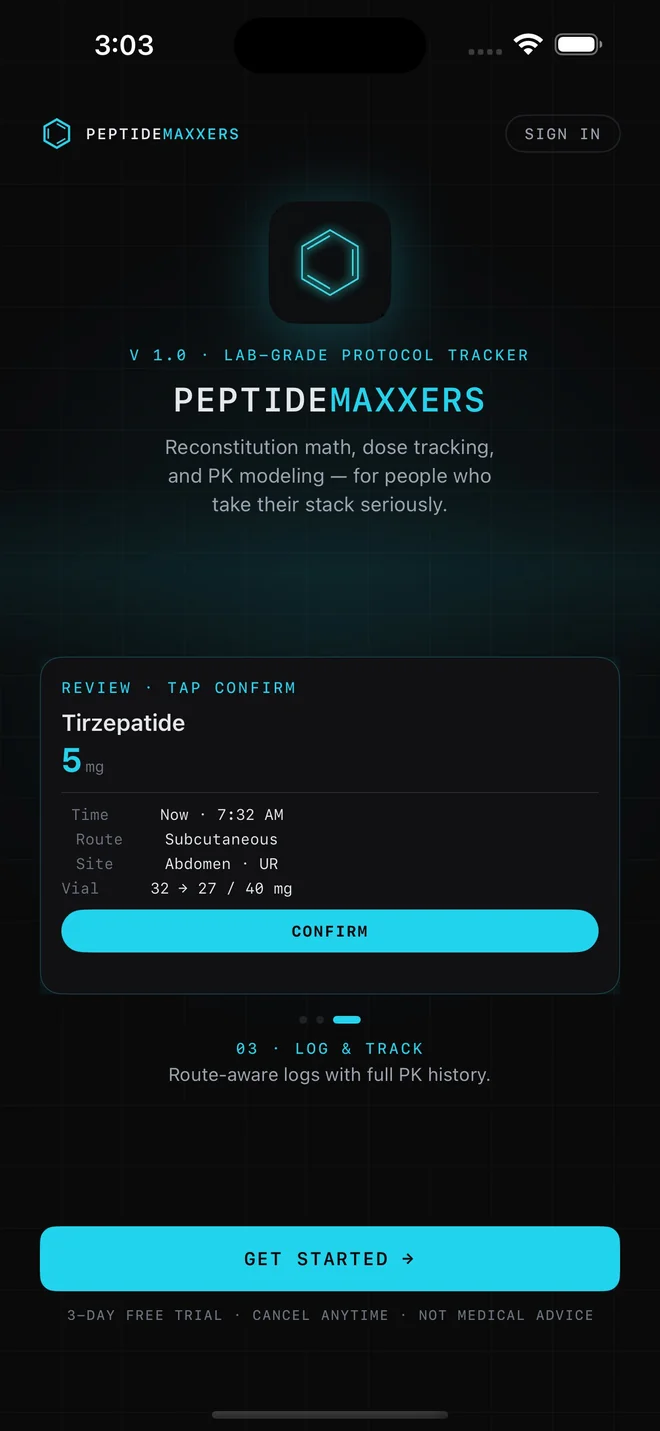
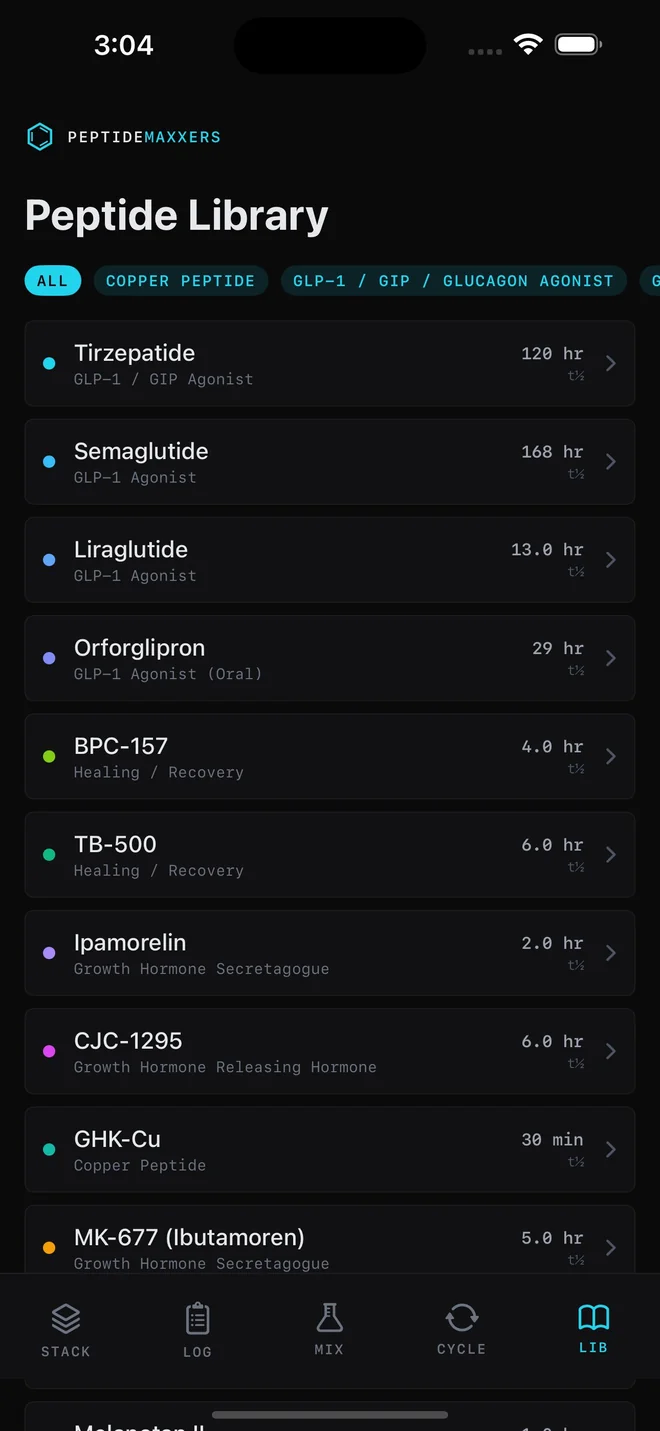
This calculator handles the math. The app handles the protocol.
Semaglutide dosage, reconstitution, and titration guide
Semaglutide is a GLP-1 receptor agonist developed by Novo Nordisk and marketed as Ozempic® (type 2 diabetes, up to 2.0 mg weekly) and Wegovy® (chronic weight management, up to 2.4 mg weekly). Both are FDA-approved pre-filled pens delivering the same molecule at different max doses. Research-format compounded Semaglutide is the same peptide in lyophilized vial form, available through licensed 503A compounding pharmacies under the FDA's ongoing shortage safe-harbor framework (capped at ≤4 prescriptions per month per patient as of the February 2025 resolution guidance). This guide covers Semaglutide dose math, the full titration schedule, reconstitution at 2mg / 5mg / 10mg vial sizes, dosing in units vs mg, compounded vs branded differences, side effects, max-dose protocols, and the Semaglutide vs Tirzepatide comparison.
Semaglutide dosing schedule and titration
Semaglutide uses a strict stepwise titration to manage gastrointestinal tolerability — primarily nausea, which is the dose-limiting side effect. The schedule below matches the FDA-approved titration for Wegovy (weight loss) and is identical through 2.0 mg for Ozempic (diabetes, which caps at 2.0 mg). Doses are the standard clinical schedule, not medical recommendations.
| Titration week | Weekly dose | U-100 units (5mg/2mL vial) | Notes |
|---|---|---|---|
| Weeks 1–4 | 0.25 mg | 10U | Initiation — tolerability assessment |
| Weeks 5–8 | 0.5 mg | 20U | First full titration step |
| Weeks 9–12 | 1.0 mg | 40U | Ozempic standard maintenance |
| Weeks 13–16 | 1.7 mg | 68U | Wegovy titration step |
| Weeks 17+ | 2.0 mg | 80U | Ozempic max dose (diabetes) |
| Weeks 17+ (Wegovy) | 2.4 mg | 96U | Wegovy max dose (weight loss) |
Semaglutide reconstitution — 2mg, 5mg, 10mg vials
The 5mg lyophilized vial is the most common research Semaglutide format. Reconstitution at 2mL of bacteriostatic water yields a 2.5 mg/mL concentration — the standard working concentration where every titration step pulls to a clean U-100 mark (0.25mg = 10U, 0.5mg = 20U, 1mg = 40U, 2mg = 80U, 2.4mg = 96U). The 2mg vial with 1mL BAC yields 2 mg/mL. The 10mg vial with 2mL BAC yields 5 mg/mL (halves every draw — useful for users already at 2mg+ maintenance).
Semaglutide dose in units — U-100 syringe reference
Users switching from branded Ozempic or Wegovy pens to research vials often ask how to convert "clicks" to units. Pens deliver a fixed volume per click (~0.74 mL per dose at Ozempic's 1 mg concentration), which translates to a specific mg dose. With research vials and U-100 syringes, you measure in units. The conversion depends entirely on your reconstitution concentration. At the standard 2.5 mg/mL (5mg vial + 2mL BAC water), the unit marks line up cleanly: every 0.25mg = 10 units. Above, the calculator computes this live for any vial/BAC combination.
Compounded Semaglutide vs Ozempic vs Wegovy
All three contain the same active peptide — semaglutide — but differ in regulatory status, presentation, and maximum dose. Ozempic® is Novo Nordisk's FDA-approved pre-filled pen for type 2 diabetes, available at 0.25, 0.5, 1.0, and 2.0 mg weekly doses. Wegovy® is the identical molecule in a pre-filled pen FDA-approved for chronic weight management, available at the full 0.25 → 2.4 mg titration. Compounded Semaglutide is the same peptide in lyophilized vial form, prepared by licensed 503A compounding pharmacies and dispensed by prescription. Under the FDA's February 2025 shortage-resolution guidance, 503A compounding is capped at ≤4 prescriptions per month per patient. Compounded versions are chemically equivalent when sourced from reputable pharmacies but lack the pen delivery system and require manual reconstitution and U-100 syringe draws.
Semaglutide for weight loss vs type 2 diabetes
The underlying mechanism is identical across indications. For type 2 diabetes (Ozempic labeling), semaglutide is dosed up to 2.0 mg weekly and produces 5–10% weight loss as a secondary effect alongside primary glucose control. For chronic weight management (Wegovy labeling), semaglutide is dosed up to 2.4 mg weekly and produces 14–16% mean body weight reduction over 68 weeks in clinical trials (STEP-1 study). The higher Wegovy dose is the only meaningful pharmacological difference — everything else (molecule, delivery, titration pattern through 1.7 mg) is identical. Users running research protocols can select their target dose based on their goal: 1.0–2.0 mg for glucose-control research, 2.4 mg for maximum weight-loss effect.
Semaglutide side effects
Side effects are overwhelmingly gastrointestinal and are the reason the titration schedule exists. Nausea is the most common adverse event, peaks during titration steps, and partially adapts during maintenance. Slow titration and eating lighter meals for 24–48 hours after each injection reduce severity. Vomiting and diarrhea occur in a minority and are more frequent at 2.0+ mg doses. Constipation is common at all dose levels. Decreased appetite is the intended therapeutic effect and is universal. Mild heart rate elevation (~3–5 bpm) is observed clinically. Rare but serious: pancreatitis risk (most relevant for users with a personal or family history), medullary thyroid carcinoma (boxed warning — contraindicated with MEN2 or personal/family history of MTC), gallbladder disease during rapid weight loss. Injection-site reactions are minimal compared to other subcutaneous peptides.
Semaglutide vs Tirzepatide
Semaglutide and Tirzepatide are the two most widely used incretin-mimetic peptides, but they differ mechanistically. Semaglutide is a GLP-1 receptor monoagonist — it activates only the GLP-1 pathway. Tirzepatide (Mounjaro/Zepbound) is a dual agonist activating both GLP-1 and GIP receptors. In head-to-head clinical data (SURMOUNT-1 vs STEP-1), Tirzepatide 15 mg produced ~21% body weight reduction at 72 weeks vs Semaglutide 2.4 mg's ~15% at 68 weeks. Both use weekly subcutaneous injection with similar titration logic. Semaglutide has longer real-world use, more cardiovascular outcomes data (SELECT trial showed 20% reduction in major cardiovascular events), and is typically less expensive. Tirzepatide produces larger weight-loss effect and often better glycemic control. Users running research protocols can calculate dosing for either compound on the /tirzepatide/ or /semaglutide/ calculators.
How long can you take Semaglutide?
Unlike research peptides that are conventionally cycled (BPC-157 on/off, Tesamorelin 12–16 week cycles), Semaglutide is designed for continuous long-term use. Clinical trials run 68 weeks (STEP-1, Wegovy) or longer (SUSTAIN-6, diabetes outcomes). Discontinuation consistently produces weight regain — roughly two-thirds of lost weight within 12 months of stopping per the STEP-4 extension study — which is why clinical guidance treats semaglutide as chronic therapy for chronic disease. There is no documented tolerance or receptor desensitization at standard doses; continuous weekly dosing maintains efficacy indefinitely.